12.05.2020 – 11.20 – 1934 was the year of the “great demolitions” in Trieste. The new mayor, Enrico Paolo Salem, started a restoration plan to radically transform the old city center while another part of the city – the Roman heritage – was brought to light, another portion – the medieval and modern core – was irreparably lost.
The “healing pickaxe” destroyed 181 houses between 1934 and 1937; in addition to a stable, a hotel and 373 warehouses and shops. Over two thousand families were relocated, mostly rehoused elsewhere at the expense of the municipality.
The newspapers of the time conveyed the enthusiasm to eliminate the “old” and leave room for the “new” a desire to make tabula rasa on the rubble of previous centuries.
The French architect Le Corbusier wrote that demolishing is like performing a surgical operation; even if done successfully, a scar remains on the skin, sometimes slight, sometimes showy.
In the case of Trieste, it is more the removed organs than the scars that are missing, think of the destruction of the many 17th century houses; or the disappearance of Casa Montecchi, dating back to 1438 (via S. Maria Maggiore n.2); or Casa Piccardi, dating back to 1514 (via Pozzo del Mare); or the House of the Bavarians (via della Rena n.352) where the bodyguards of the King of Greece, Ottone di Wittelsbach (1835), had stayed.
As sung by the dialectal poet Corrai, alias Raimondo Cornet, the “Podestà Piccon” was deaf to critics and continued undaunted with the redevelopment.
Infati, apena confermado in carica
el se fa preparar progeti e piani
per trasformar Trieste in pochi ani
e darghe un novo aspeto a la zità.
Dito e fato, el picon se meti in opera,
I protesta? No ‘senti de sta orecia.
devi sparir le case in zità vecia…
(In fact, just confirmed in office
he gets projects and plans prepared
to change Trieste in a few years
to give the city a new look…
Said and done, the pick begins to work,
Protests? These ears can’t hear…
the houses of Citttavecchia must disappear)
In fact, the plans for a complete redevelopment of Cittavecchia date back much earlier; the one carried out by Salem was neither the first nor the last attempt to provide a rational layout to the patchwork of houses and alleys in the old town.
When Trieste was under the rule of Austria, starting from the 1880s, the ruling power begun to evaluate how to recover “Citavecia” with particular reference to its lower part. The impoverishment and criminalization of the district had started in 1870, when professionals and government employees had started to move elsewhere, giving the apartments to poor immigrant families.
Ten years later, the Civico Officio alle Pubbliche Costruzioni (Civic Construction Office ) presented the first urban development plan which provided for the destruction of numerous side streets in favor of two longitudinal roads, corresponding to Via San Sebastiano and Via di Riborgo and Via Crosada.
Five years later (1885), the Milanese engineer Enrico Prevosti, as representative of the Lombard Building Society, presented the Municipality with a redevelopment plan that foresaw the destruction of the lower part of Cittavecchia. The Palazzo del Comune was to be enlarged with three buildings for the Civic Museums, while the Palazzo della Borsa had to house the Civic Library.
A single street on the slopes of the hill would have winded from Piazzetta San Giacomo to Via del Bastione.
The next project, three years later (1888), was even more ambitious: conceived by the engineer Federico Comelli, it envisaged a “disembowelment” of the historical nucleus to be carried out gradually over 12 years, with 1632 houses demolished and 7136 people displaced. A covered market would have been built in a part of Via Donota, while between the Town Hall and the Riborgo Comelli palace he had designed a 120- metre-long crystal gallery, crowned by a dome with a diameter of 26 metres, all surrounded by a series of porticoes.
Comelli’s gallery was already an imposing project; but it seemed little compared to what architect Ervino Escher proposed at the dawn of the First World War (1913).
The project, with its pharaonic dimensions, if it had been realized would have made today’s Trieste unrecognizable, projecting it in a completely different direction; certainly, majestic and scenic, but poor in humanness, like any city that renounces to a part of its history.
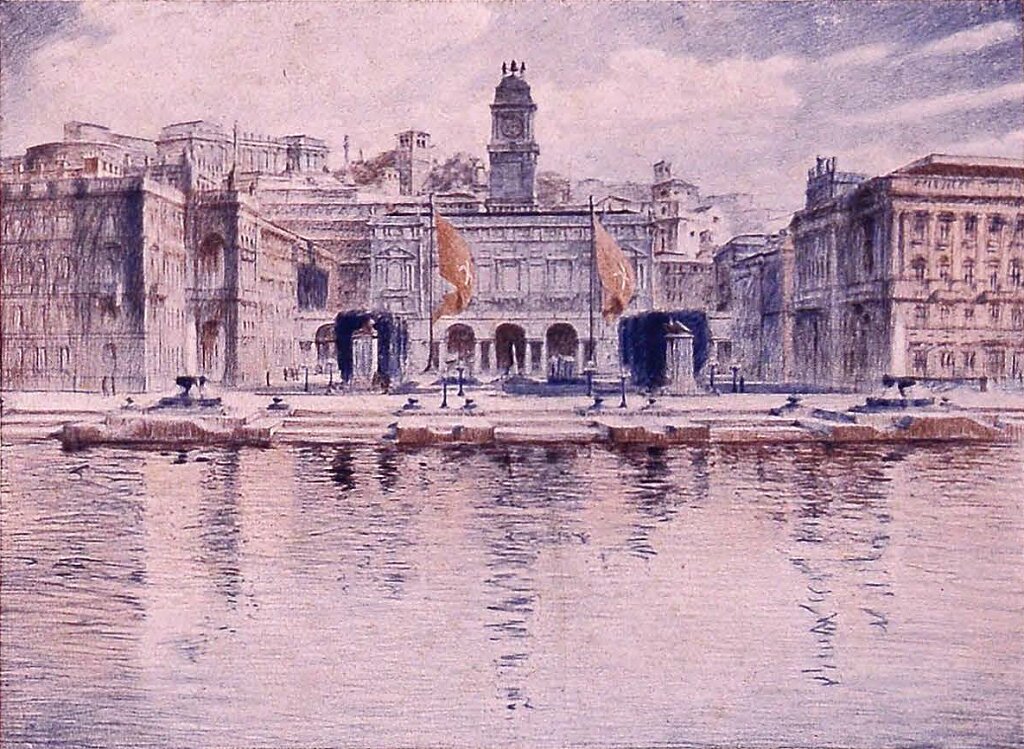
Escher’s project was in fact to reshape not only the hill of San Giusto, but also Piazza Grande (today’s Piazza Unità). The main road for traffic in the flat part of Cittavecchia would have consisted of a single road, starting from Via Ponterosso, continuing to the Scuola popolare di Piazza vecchia, passing through Via Santa Lucia and taking advantage of Via dei Rettori and part of Via Crosada.
The hill of San Giusto would instead have been remodeled through a monumental staircase and a winding carriage road. The same hill would have been divided in turn into five horizontal terraces; the first four were intended for luxury accommodation, the last one at the Museum of History and Art of Trieste. The main staircase would have been located in the area of today’s Roman Theater, and would have given access to each of the terraces.
Cittavecchia: starting from the new monumental Museum. Positioned next to the cathedral, the Museum would have been composed of a 12-metre-high basement, surrounded by three gigantic colonnades; one would have connected the cathedral and the museum, another the grand staircase and a third one a square in honor of San Giusto. The serpentine road, in turn, started from a semicircular square in front of the Church of Santa Maria Maggiore, whose ornate facade would no longer be hidden, but would be the first part of a chain of monumental works, placed at every step of the road.
Descending from the hill to Piazza Grande, Escher had remodeled the town center itself: The Town Hall of the architect Giuseppe Bruni had to be demolished. The monumental staircase would in fact continue from the hill to the Rive, accessing the water through three steps. The banks in front of the square would appear divided by two fountains consisting of two quadrangular boulders. The project also envisaged a bronze statue of Dante Alighieri at the top of the steps, surrounded by flowerbeds.
In the part behind the two fountains the architect had finally placed two groves, each
marked by a monumental pylon; one with an eagle and one with a lion. Escher’s project – almost an architectural fantasy, an extravagant urban mirage – met with a certain success with the public; his drawings were in fact exhibited at Palazzo Modello. The many classical references, as well as the statue of Dante Alighieri, indicated that the project was in tune with the liberal-national class in government at the time in Trieste. Dante at the time was not only seen as a man of letters, but a symbol for the Italian irredentist fringe.
The young irredentists had holy pictures of Dante in their jackets, the Lega Nazionale itself used him as a symbol. A medieval figure like Dante, detached from the 19th century concept of nation-state, had in this way experienced a cultural involution, being transformed into a Risorgimento icon. Placing a statue of Dante there meant sending a clear message, only partly tempered by the pylon with the Austrian eagle.
The catastrophe of the First World War, which was fast approaching, would soon
transform these statues and proclamations into a deadly game of machine guns and
trenches.
Sources: Ervino Escher, Progetto di ordinamento definitivo della Piazza Grande e del Colle di S. Giusto, Tip. L. Herrmanstorfer, Trieste, 1913
Author: Zeno Saracino
Michael Guggenbichler translation