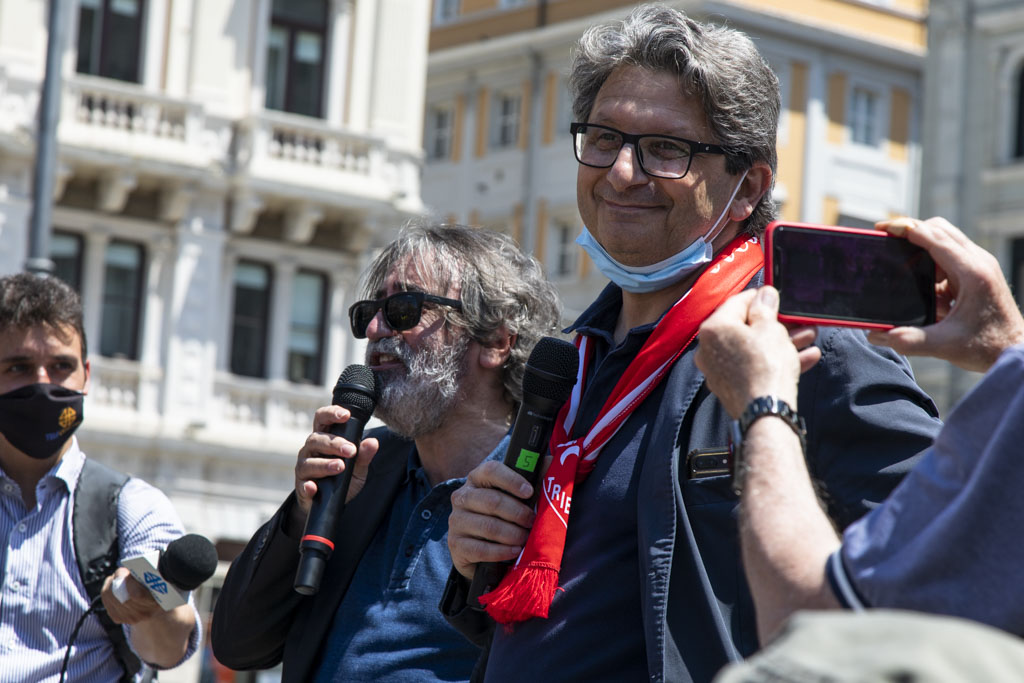
14.06.2020 – 20.40 – “This square is called Unità; and today more than ever there is a need for it.
Let’s not let them take away what we’ve done, don’t allow it to be taken away”.
Strong and clear, as usual, the words of Zeno D’Agostino addressed around one o’clock in the afternoon of June, 13th, to the workers, trade union representatives and citizens who filled the square as a demonstration not only of the respect and affection that Trieste feels towards Zeno D’Agostino and Mario Sommariva, who went on stage with him, but even for the dockers and the work done in the last years.
The port is the pride and joy of a city that wants to return to be a major player, and that is no longer so easily willing, as it once was (and for a long time), to remain silent.
Together with the citizens, politic representatives of one or the other side, have come together to support D’Agostino (before the Anac judgment, however, they not always did; the square is consensus, and therefore at the moment when one shouts: ‘There is only one president!’, one must be there, even if until two weeks ago a few words said by D’Agostino were a bit annoying. So, it is and always has been).
It should be remembered that in the world Trieste is still considered a small town of just 200,000 inhabitants; a little better known than in the past, and
sometimes confused with a Slovenian capital (something that unfortunately still happens today in Italy).
Hamburg, the port of which stretches almost beyond the horizon line when you
look at it from the viewing tower, has almost two million inhabitants and
Rotterdam 640 thousand.
The fact that the Julian city found itself playing, with Zeno D’Agostino and
Mario Sommariva, a significant geopolitical role in the promotion of integration between Europe and Asia, has attracted not only praise and recognition but also reactions and enemies to the presidency of the Port System Authority, particularly because of the signing of the agreement in principle with China, which has set Trieste, and not the Ligurian ports (which would have been preferable, for the Italian government at the time, but also for the current one in the Conte-Conte administration) as the western end of the New Silk Road, key to the political action of President Xi Jinping.
Zeno D’Agostino, who was, until a few days ago, president of the Authority itself (and still is today, in the heart of the people of Trieste, who have clearly proved it with the demonstration in Piazza Unità), declared on several occasions in 2018 and 2019 that the Chinese, and therefore their government, as nothing owned by the Chinese is actually private property, are ready to invest a lot of money in Trieste’s infrastructure, attracted by its geographical location and the network of railway connections that Trieste inherits from its past as a gateway between Central Europe and the East (it is easier, from Trieste, to reach the heart of Europe than the heart of Italy).
The port of Trieste, with D’Agostino and Sommariva, has been able, among the jealousies of other ports and the obstacles put in the way by the politics of both nations and our country, to remain on the cutting edge, reaching not only the expectations of growth but going beyond them.
The port doubled in less than four years the number of transited TEUs (the standard size for goods transported by container, equivalent to a length of 20 feet: “twenty-foot equivalent unit”, about 6 meters), and freight trains, the
expansion of usable spaces, and the extension of activities.
All this was slowed down only by the lack of resolution on the free-port issue and on the processing under extra-customs regime.
Europe is waiting for Trieste to be available, the companies are ready to invest and Rome has not yet implemented the decisions taken.
D’Agostino has always stressed the importance of another point as well: investors, i.e. the countries of the European Union and China, have an interest in an integrated system, which Trieste is becoming, not only in the construction of new terminals, piers and warehouses; all this would not be enough, if everything were not put together and transformed into a machine that works and produces added value.
The port of Trieste needs at least 1.5 billion euros of investment for its development, especially for the industrial area outside the customs and within which the Servola ironworks chapter should not be forgotten; of this money the Chinese had declared willing to invest about 750 million euros, along with expressions of interest from other EU countries, Kazakhstan, Azerbaijan, Malaysia, Turkey and Iran.
And, underneath (not even that much), Russia.
It is in the view of all this that Anac’s decision, in the opinion of a large part of Trieste’s entrepreneurial society, of politics and even of jurists, seems incomprehensible because focused on a formalism.
To resolve what in a context of European economy and politics has the weight of a quibble and ends up damaging not only Trieste but the whole of Italy just when there is an extreme need for a relaunch, we risk throwing away the harmony of an excellent team.
The yellow-green Italian government, with Giuseppe Conte and Luigi Di Maio, had clearly expressed their intention to support the Chinese plans and the development of the port of Trieste; however, this was during the first legislature, while in the second one, with the change from ‘green’ to ‘red’, the question of the free-port still remains a dead letter and now sees D’Agostino
under fire, even though Stefano Patuanelli himself expressed his full support.
Trieste, after Italy has already signed the MOU (Memorandum of Understanding) with China by adhering to Xi Jinping’s mega-project, could become part of the New Silk Road very soon, and without ‘selling’ the port to
the Chinese: countless times it has already been explained, both by the Port
System Authority with D’Agostino, and by the Government, and by the professionals (and protagonists) of logistics and transport, how this is impossible: Italy would not ‘sell’ any assets to China, which would only purchase minority shareholdings in already existing activities.
If the problem, however, is the interest of China, Iran, Russia and Turkey in Trieste, then the scenario shifts to a higher level, and sees other significant
international players, one above all the United States, worried about an
excessive ‘independence’ of Italians on the Chinese issue and the risk that the European horizon will end up tilting more towards Beijing rather than
Washington, also generating concerns related to security, and even the fear that the Chinese presence in the port of Trieste could facilitate espionage activities on NATO traffic in the Mediterranean and military activities in Central Europe.
D’Agostino denied such concerns with determination, stressing that there is a
clear separation, in Trieste, between civil and military activities, and that this
applies to all European terminals.
A future that still looks to a port – or more properly, to an integrated logistic
system that includes the transformation into an extra-customs regime – as
initially complementary to that of Piraeus, and then who knows, perhaps even
stronger with millions of TEUs of traffic moved through high-speed railway
lines, is at the gates: Trieste cannot miss it.
Certainly, the weight of politics is great, and more than ever before, Rome is needed to move forward.
Author: Roberto Srlez
Michael Guggenbichler translation